ETF composition data is easy to underestimate. A spreadsheet may look like a straightforward list of securities and weights, yet the same fund can be represented by a full holdings file, a creation basket, an index constituent list or a short top-holdings table. Those records may overlap, but they are not interchangeable. Treating them as identical is how a portfolio screen, exposure report or historical comparison starts with the wrong premise.
The practical goal is not to collect the most ETF-related rows. It is to know exactly what each row represents, when it was true and whether the fields can support the job at hand. This guide explains the layers inside ETF composition data and the checks that turn a file into something a research or data team can use with confidence.
What ETF composition data actually describes
An ETF pools investor money into a portfolio of securities, cash and other assets. Investor.gov describes the combined assets as the ETF's portfolio, and each share represents an ownership interest in that portfolio. Investor.gov's ETF overview is a useful starting point because it separates the fund from the individual securities it owns.
Composition data is the operational view of that portfolio. At its best, it identifies the ETF, identifies each constituent, states the position size and preserves the date supplied by the source. It may also add classifications such as sector, industry, country, currency, security type, fixed-income characteristics and durable identifiers. That additional context is what lets a team answer questions about exposure instead of simply displaying a list.
A top-ten holdings widget is composition information, but it is not necessarily a complete composition file. It may omit smaller positions, cash, swaps, futures or details needed to reconcile weights. Before a file enters a model, dashboard or client workflow, ask one basic question: does it describe the complete reported portfolio, an operational basket or the benchmark the fund is trying to follow?
Separate full holdings, baskets and index constituents
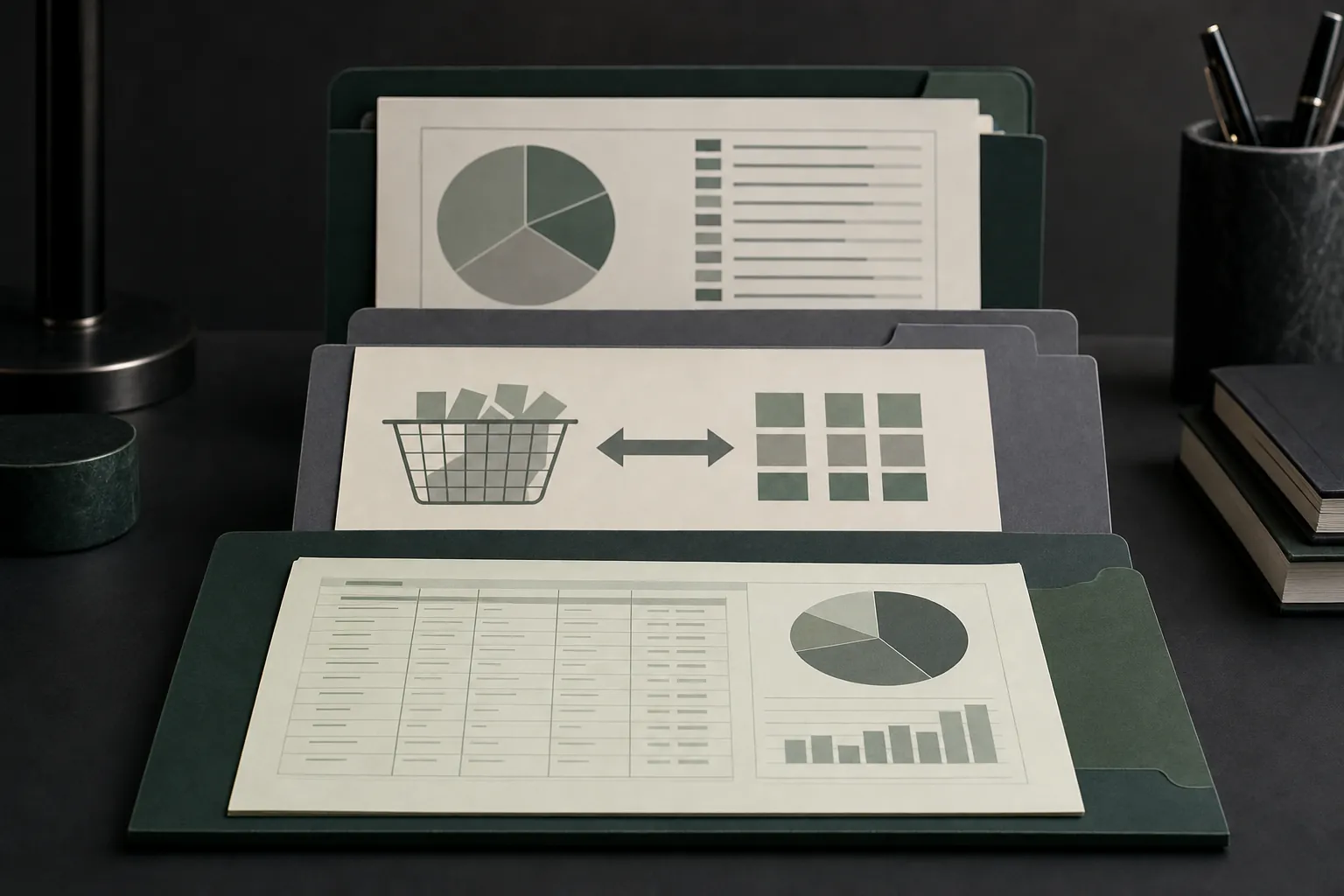
These three data sets often look similar. They can contain the same ticker symbols and even similar weights. Their purpose is different, which means their differences can be material.
The three lists a team may encounter
- Full ETF holdings: the securities, cash and other assets the fund reports owning at a stated point in time.
- Portfolio composition or creation basket: the securities and cash used in the ETF creation and redemption process.
- Index constituents: the members and weights of the benchmark, not necessarily the exact fund portfolio.
Full holdings are the right object when the job is to understand the fund's actual reported exposure. They can include cash, derivatives, temporary positions and implementation details that do not appear in a benchmark. For ETFs relying on Rule 6c-11, the SEC requires portfolio holdings disclosure each business day, an approach designed to support intraday valuation and the creation-redemption mechanism.The SEC's staff statement on ETF portfolio disclosure explains why current, position-level information matters to market participants.
A creation basket serves a different operational role. Fidelity defines a portfolio composition file as the list of securities, cash or other assets exchanged in the ETF creation and redemption process, and notes that full holdings can include assets that are not included in that file.Fidelity's explanation of portfolio composition filesis a clear reminder not to use a basket as a shortcut for a complete portfolio without checking the provider's definition.
Index constituents describe the benchmark. They are essential for benchmark research, rebalancing analysis and index-product workflows, but a fund can differ through sampling, cash balances, fees, timing, corporate actions or portfolio-management decisions. A prospectus can state this directly: one SEC filing notes that a fund's portfolio holdings may not exactly replicate the securities or ratios in its index.This SEC filing's discussion of non-correlation risk gives the practical reason to keep fund and benchmark records distinct.
Build the identity layer before comparing weights
Weight is often the first field an analyst looks for, but identity comes first. A usable composition file should establish the ETF or index being described, the source date, each constituent's name and a stable identifier where available. Ticker alone is rarely enough for a durable workflow because symbols can change, multiple venues can use similar codes and a short symbol does not explain the security's currency or exchange.
For constituents, combine the provided ticker with identifiers such as CUSIP, ISIN, FIGI or Bloomberg Global ID when the source carries them. Retain exchange, currency and security type alongside the identifier. That gives a downstream process a way to distinguish a common share from a depositary receipt, preferred security, bond, cash position or derivative exposure instead of trying to infer it from a name.
AmericanETP's field definitions show the identity, exchange, currency and classification fields available in its constituent files. Reviewing the schema before an import is faster than discovering later that a position cannot be matched across your research, risk or reporting systems.
Use weights, quantities and values together
A percentage weight is useful because it makes concentration visible quickly. It is not enough by itself. A weight can be rounded, stale, derived from a different valuation point or affected by cash and derivative positions that are not obvious in a short table. Quantities, market value, notional value where relevant, price and currency provide the context needed to test whether the file tells a coherent story.
Start with a simple reconciliation: do the reported weights add up to a reasonable total for the source's stated methodology? A small difference can be normal because of rounding, cash or delayed values. A large unexplained difference deserves investigation before it is pushed into a portfolio calculation. Keep negative values and unusual security types visible rather than stripping them out, especially for leveraged, inverse, fixed-income or derivative-based funds.
The relevant checks change with the fund. An equity fund may need sector and industry detail. A bond ETF may require coupon, maturity and rating. A global product may need currency and country context. TheETF constituent data overview shows the broader field groups that help teams handle those differences in one repeatable structure.

Dates and delivery timing are part of the data
ETF composition is not static. A file that was correct at yesterday's close can be misleading for a workflow meant to describe today's exposure. Preserve the as-of date supplied for the portfolio, then keep the file delivery time separate. Those are related timestamps, not always the same thing: a provider may publish a file after processing a portfolio that was valued at an earlier point.
The distinction matters when files are compared across funds. If one portfolio is from a prior business day and another is more current, an apparent difference can be a timing mismatch rather than a genuine investment decision. It also matters when an issuer corrects a file. A reliable process should retain the source version or retrieval date so an analyst can explain why a row changed after the fact.
For a first implementation, test a small group of familiar funds over several delivery cycles. Compare a broad equity ETF, a fixed-income ETF and a fund with more complex exposure if they are in scope. That sample quickly reveals whether the source handles holidays, cash, substitutions and different security types in a way your workflow can understand.
Historical composition turns a snapshot into analysis
Current composition supports a current exposure view. Historical composition supports change analysis: identifying when a constituent entered or left a fund, measuring a weight shift, reproducing a past report or testing what a portfolio looked like before a market event. The essential requirement is not merely a folder of old files. It is a dated sequence with stable enough fields to compare one period with another.
The site's guide to historical ETF holdings covers the archive checks worth making before relying on a past portfolio. When a team needs both current monitoring and historical context, the most useful source combines a clear current delivery rhythm with records that can be retrieved and interpreted later.

Do not let classification become an assumption
A constituent name and weight do not fully describe an exposure. The same portfolio can hold common equity, preferred shares, depositary receipts, cash, futures, options, swaps, bonds or fund shares. If a file flattens those positions into one generic security label, an exposure calculation may look complete while quietly omitting the distinctions that matter to the person reading it.
This is especially important when a process groups positions by sector, industry, country or asset class. A sponsor's sector label may be the right reference for one report, while an independent classification system is required for another. The key is to retain the provided classification, document the convention and avoid silently replacing it with a guess. That makes the output easier to audit when a user asks why a holding was assigned to a particular bucket.
Fixed-income and derivative positions need the same discipline. Coupon, maturity, rating and notional value can be more informative than an equity-style share count. A cash position may be operationally small but still explains why equity weights do not sum to exactly one hundred percent. The guide toETF fundamental data explains how the fund-level profile adds another layer, including ETF type, leverage, assets and total holdings. Used together, fund-level fields and constituent classifications make it easier to separate a simple equity portfolio from a product with more complex implementation.
Teams also benefit from keeping the original source fields available alongside normalized columns. A clean reporting layer is useful, but a trace back to the supplied name, identifier and classification can save a great deal of time when a sponsor changes a label or a security type appears for the first time. TheETF holdings data guide covers the broader checks that help a daily file remain dependable after it enters an automated workflow.
A practical acceptance checklist
Before relying on ETF composition data in production, take one file beyond a visual review. Load it, compare it with a familiar fund and document what each important column means. A source that passes this small test is more valuable than a larger file that requires a new manual workaround every morning.
Questions to answer before the file goes live
- Is this complete fund holdings, a creation basket, index constituents or a limited summary?
- Does each file include a clear as-of date and a dependable delivery convention?
- Can every constituent be identified beyond a ticker when the workflow requires it?
- Are weights, quantities, values and currencies sufficient to reconcile meaningful exceptions?
- Are cash, derivatives, fixed-income positions and unusual security types clearly represented?
- Can the same file structure be compared across funds and retrieved again for historical work?
These questions also make vendor evaluations more direct. Instead of asking whether a provider has ETF data in general, a team can ask whether the exact field set, update timing, coverage and archive depth fit the job it needs to perform.
How AmericanETP supports composition-data work
AmericanETP provides daily ETF and index constituent files designed around the information a team needs to inspect composition: constituent and composite tickers, names, weights, identifiers, shares held, market value, exchange, currency, sector, industry and fixed-income fields where applicable. The publicdata coverage page outlines the current ETF, index and archive scope, while the reports page provides direct paths to current reference files.
The value is not a decorative holdings table. It is a dated file structure that a research, data or reporting team can inspect before building around it. For workflows that need past composition as well as today's records, AmericanETP maintains constituent-list archives beginning in 2009 for qualifying subscribers.
The useful next step is to review trial access, open the current files and map the fields against the process you already run. That is the quickest way to determine whether the data model fits without making assumptions from a marketing description.
Frequently asked questions
What is ETF composition data?
ETF composition data describes the securities, cash, derivatives and other positions associated with an ETF, together with fields that identify and size those positions. The term can refer to complete fund holdings, a portfolio composition file used for creations and redemptions, or an index constituent list, so the source and as-of date need to be explicit.
Are ETF composition files the same as full holdings?
Not always. A portfolio composition file can describe the creation or redemption basket used by authorized participants, while full holdings describe the assets reported inside the fund. The lists can overlap heavily, but cash, substitutions, derivatives and operational adjustments can make them different.
Are ETF constituents the same as index constituents?
No. ETF constituents are the positions associated with the fund, while index constituents are the components of the benchmark. A fund may closely replicate an index, but sampling, cash, fees, timing, corporate actions and trading can create differences between the two lists.
Which fields matter in ETF composition data?
Start with the fund identifier, security identifier, constituent name, weight, quantity, market value, currency, security type and as-of date. Add exchange, sector, industry, fixed-income details and sponsor identifiers when the workflow needs deeper classification or cross-system matching.
How often should ETF composition data update?
The right schedule depends on the intended use, but daily data is the practical baseline for a workflow that monitors ETF portfolios or reconciles changes. The important point is to retain the source's as-of date and delivery time, because a current-looking file without timing context can still be stale.
Inspect current ETF composition fields before you build around them.
Review the file structure, compare the fields with your workflow and confirm the delivery pattern before you subscribe.