A current ETF holdings file tells you what a fund reports owning now. Historical ETF holdings tell you what it reported owning then. That one difference changes the questions the data can answer. A current snapshot can support a screen or a quick exposure check. A dated archive can help explain a past result, rebuild a portfolio view, investigate a rebalance, validate a model or answer the awkward question that tends to arrive after the report has already gone out: "What did the fund actually hold on that date?"
For an analyst, developer or data team, history is not an optional extra. It is how a holdings file becomes defensible. Without the original date and source record, it is easy to project today's portfolio backward and accidentally treat a recent constituent list as evidence of an earlier exposure. That is a tidy spreadsheet error with very untidy consequences.
This guide explains what historical ETF holdings are, where the gaps usually appear and what to check before building a process around an archive.
Historical ETF holdings are dated portfolio snapshots
An ETF holds a portfolio of securities, cash positions and other assets. Investor.gov describes an ETF portfolio as the combined holdings that the fund owns on behalf of investors. Investor.gov's ETF overview is a useful baseline. Historical holdings are the same kind of portfolio record, preserved with the date that gives it context.
A usable snapshot should identify the fund, state an as-of date and provide enough detail to understand each position. At minimum, that usually means the security name, ticker or other identifier, quantity, portfolio weight and a description of the asset. More complete files can include market value, price, currency, exchange, security type, sector, industry, coupon, maturity, rating and fund-level fields.
The date needs to mean something precise. It may be the date the issuer used for the portfolio, the business date of the constituent file, a creation-basket date or a provider's processing date. Those are not automatically interchangeable. When the data source does not make that clear, you cannot safely assume that a row labelled "July 1" represents the same point in the workflow as another provider's "July 1" file.
Why current holdings cannot answer historical questions
A current file can show the securities an ETF owns today, but it cannot prove what the fund held before a rebalance, a corporate action, a market shock or a change in the underlying index. Weightings move as prices move, even when the fund has not traded. A position can also enter, leave, split, merge, mature or change identifier. Looking at a live page after the fact is often useful context, but it is not a historical record.
The distinction matters in common workflows. An exposure report may need the portfolio that existed at month-end. A portfolio-overlap model may need the holdings that were available when a recommendation was made. A performance review may need to know whether a large position was already present before a move. A data team may need to reproduce the exact file that populated a client report. Those are all dated questions.
The SEC's ETF guidance under Rule 6c-11 illustrates why holding-level detail and timing matter. The rule's disclosure standard includes items such as a ticker symbol or other identifier, description, quantity and percentage weight for each holding. The SEC's ETF compliance guide provides the regulatory details. For historical work, the same fields need to travel with an exact date so a team can explain what the portfolio looked like at that moment.
What historical holdings can show
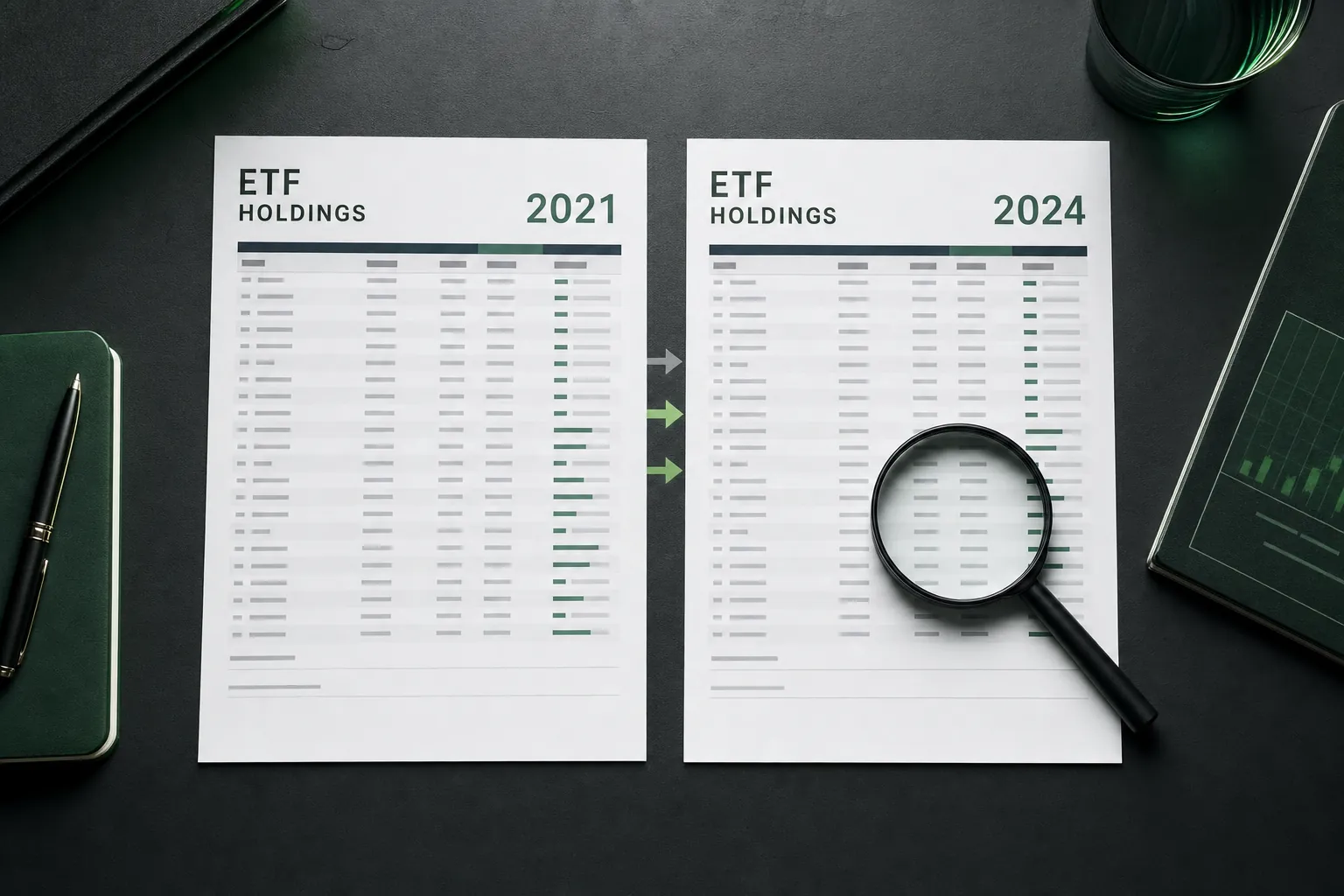
With a clean series of dated files, a team can move beyond a single portfolio snapshot. It can identify additions and removals, measure position-size changes, track a security's weight through time, compare sector or country exposure across dates and investigate how a fund changed around an index rebalance or manager decision.
The most useful analysis separates three different effects. First, a position can change because the fund bought or sold it. Second, its weight can change because its price moved relative to other holdings. Third, the way a file is expressed can change because of a corporate action, identifier update, sponsor methodology change or source-system revision. An archive cannot remove those differences, but it gives you the evidence to distinguish them instead of guessing.
Historical holdings are also valuable for validation. A model that claims to have used an ETF's exposure from a past date should be tested against the holdings available at that date. A report built from a dated portfolio should be reproducible from the same record. This is especially important when the work feeds research, risk controls, client reporting or any process where someone else needs to understand how the result was produced.
Holdings, baskets and index constituents still need to be separated
An archive is only useful if it preserves the right object. Full ETF holdings, portfolio composition files and index constituent lists can look similar, but they are not the same thing. Full holdings describe the fund's reported portfolio. A portfolio composition file is tied to the creation and redemption process. Index constituents describe the underlying benchmark rather than necessarily the ETF's complete portfolio.
Fidelity explains that a portfolio composition file can include securities, cash or other assets used to create or redeem ETF shares, while a fund's full holdings can include items that do not appear in that basket. Fidelity's explanation of ETF portfolio composition data is a clear reference for the distinction. When you are looking backward, that distinction matters even more because a basket or index list can be mistaken for the portfolio that actually drove the ETF's exposure on that date.
Write down the object your workflow requires before comparing providers: the full fund portfolio, a creation basket, an index constituent list, fund-level statistics or a combination of them. A source that labels everything "holdings" may still leave you with a mismatch that surfaces only after you try to reconcile a historical result.

The fields that make an archive usable
Start with identity. A ticker and security name are useful, but history creates situations where they are not enough. Tickers can change, be reused or follow local exchange conventions. A durable identifier such as CUSIP, ISIN, FIGI or another stable source key makes it easier to join records across dates and spot a real change instead of a naming difference.
Then check position detail. Quantity, weight, market value, notional value, price and currency should be clearly defined. Weights need enough precision to be reconciled, and the file should make it obvious whether a position is equity, fixed income, cash, a derivative or another instrument. The SEC staff has emphasized that vague descriptions can be insufficient for investors and market participants to understand what a fund holds. The SEC staff statement on foreign-currency holdings gives a practical example: calling a foreign currency position simply "cash" can hide information that matters.
Finally, look for fields that make the history easier to analyse: exchange, country, sector, industry, coupon, maturity, rating, sponsor sector and security type. AmericanETP's field definitions show the kind of column-level explanation that helps a team evaluate a file before it relies on it.
Archive acceptance checklist
- Does each file state a reliable as-of date and preserve the same date convention across the archive?
- Can positions be matched across time without relying on ticker alone?
- Are additions, removals and changes distinguishable from renamed or reclassified rows?
- Do weights, quantities and market values make it possible to reconcile a portfolio?
- Does the archive cover the dates, ETFs and asset types your workflow actually needs?
- Can the files be retrieved and reloaded without turning every historical request into a manual project?
Where to find historical ETF holdings
The ETF issuer is usually the right place to start for a specific fund. Some issuers make current holdings easy to download and retain selected historical files. Brokerage research pages can help with a quick read, but the depth, archive continuity and usage rights vary. Public pages that show only top holdings are useful for orientation, not a substitute for a dated full-portfolio file.
Specialist providers become more useful when the job spans many funds or needs repeatable files. DTCC says its ETF Portfolio Data Service offers daily portfolio composition data for U.S.-listed ETFs and a historical data set from November 2007 onward. DTCC's ETF Portfolio Data Service is a good example of the questions to ask: which object is stored, how often it updates, how far back the archive goes and how the files are delivered.
Before choosing a source, test a small group of familiar funds across more than one date. Include an equity ETF, a fixed-income ETF and a fund with a less straightforward structure if those are in scope. That sample will quickly show whether identifiers, dates, cash positions, fixed-income fields and file layouts remain stable enough for the work you need to do.
How AmericanETP supports historical holdings work
AmericanETP is designed for teams that need daily ETF and index constituent files they can inspect, import and archive. Its files include identifiers, weights, shares, prices, market values, sponsor sectors, fund-level fundamentals and related fields, while the historical constituent archives extend back to July 2009 for eligible subscribers.
That makes the strongest fit a team that needs a dated, CSV-based workflow rather than a one-time holdings lookup. You can review data coverage, inspect the available reports and use trial access to see whether the field set and file rhythm fit your process before you commit.
Frequently asked questions
What are historical ETF holdings?
Historical ETF holdings are dated records of the securities, cash positions and other assets reported by an ETF at a past point in time. A useful historical record includes the as-of date and enough fields to identify, size and classify each position, so a team can rebuild a past portfolio rather than relying on today's holdings.
Can I see what an ETF held on a specific date?
Often, yes, but the answer depends on the fund and data source. Issuers may publish current files and limited archives, while specialist sources may maintain broader historical collections. Before relying on a source, confirm the archive start date, whether files are available for each business day, and whether the fields stay consistent across time.
Why is an ETF's historical holdings data useful?
Historical holdings help analysts measure how portfolio exposure changed, explain a past result, validate a model, investigate a rebalance or reproduce an earlier report. A current holdings page cannot answer those questions because it only shows the portfolio now.
Are historical ETF holdings the same as index constituents?
No. Index constituents describe the members of a benchmark. Historical ETF holdings describe what the fund reported owning on a specific date. The two may be similar for a plain index fund, but cash, sampling, derivatives, trading activity and timing can create material differences.
What should I check before using an ETF holdings archive?
Check the exact as-of date, coverage, identifiers, weights, quantities, market values, currencies, security types, file delivery timing and archive continuity. The real test is whether the same file structure lets your team compare dates without inventing a manual cleanup process for every historical request.
Check the archive before the historical question arrives.
Review AmericanETP's current files, field definitions and archive options to confirm that the dates and columns fit your workflow.