ETF holdings are the securities, cash positions and other assets inside an exchange-traded fund. If an ETF is the wrapper, the holdings are what the wrapper owns. For a plain equity ETF, that may mean shares of Apple, Microsoft, Nvidia and hundreds of other companies. For a bond ETF, it may mean Treasuries, corporate bonds, municipal bonds, cash and maturity-specific fixed income positions. For a more complex product, the list can include futures, swaps, options, currencies or other instruments.
That simple definition is useful, but it is not enough for anyone who needs to work with the data. A holdings page can help an investor understand the broad exposure of a fund. A holdings file can help an analyst, developer or data team reconcile positions, calculate weights, track changes, feed a model or rebuild a historical view. The difference is not academic. The first answers "what does this fund own?" The second answers "can I reliably use this information tomorrow morning?"
Investor.gov explains that ETFs pool money from many investors and invest it in stocks, bonds, short-term instruments, other securities or assets; the combined holdings the ETF owns are its portfolio. Investor.gov's ETF overview is a good starting point. The working layer underneath is where holdings become data: tickers, identifiers, quantities, market values, dates, currencies, exchanges, weights and classifications.
ETF holdings in plain English
Think of an ETF as a fund that trades on an exchange, and think of its holdings as the fund's inventory. Vanguard describes an ETF as a collection of stocks, bonds or other securities in a single fund that trades on major exchanges. Vanguard's ETF explanation is written for investors, but the idea carries into data work: the value and exposure of the ETF come from the assets inside it.
Holdings usually appear as rows. Each row represents one position: a security, cash amount, derivative exposure or other asset. A useful row tells you what the position is, how much of it the fund holds and how important it is inside the portfolio. The most common visible fields are name, ticker, identifier, quantity and percentage weight. Better data sets add exchange, currency, market value, security type, sector, industry, country, maturity, coupon, rating, fund identifier and date.
The word "holdings" can also be used loosely on public websites. Some pages show only the top 10 holdings. Some brokerage pages show month-end data for third-party funds. Some issuer pages publish daily full holdings. Some products publish basket data that is related to, but not identical to, the fund's complete portfolio. A serious workflow should always ask what the data represents before treating it as the source of truth.
Why ETF holdings matter
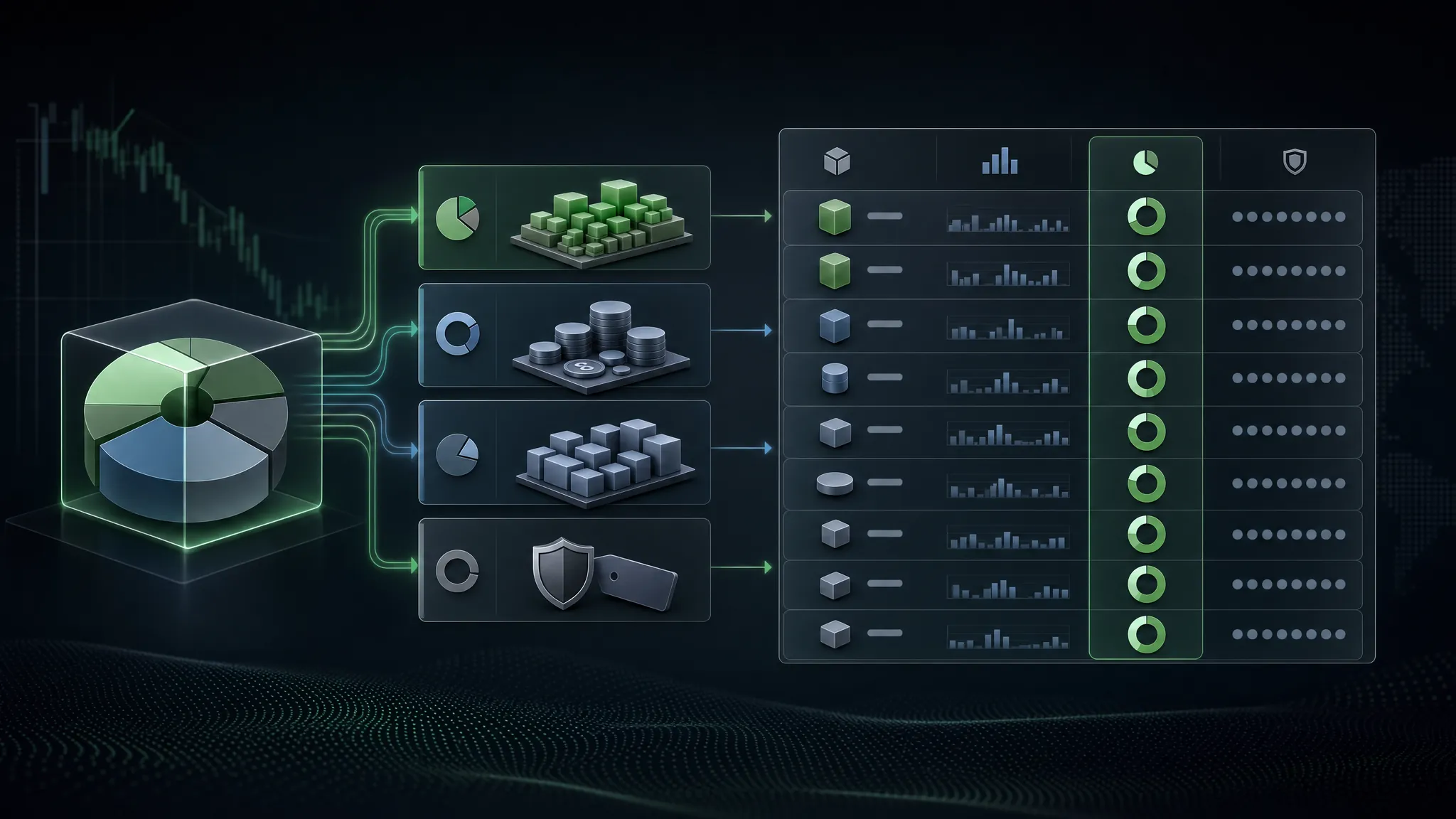
Holdings are how an investor or analyst looks through the ETF label. Two ETFs can both be called broad market funds and still have different weights, security counts, index rules, liquidity, sector exposure and country exposure. A thematic ETF may sound focused, but the holdings show whether it is concentrated in a few companies or spread across a broader universe. A bond ETF may advertise a maturity band, but the holdings show the actual bonds, coupons, ratings and maturities behind the summary.
Holdings also explain risk. If a fund has 25% of assets in a handful of stocks, the ETF may behave more like those names than like its category label. If a fixed income ETF has meaningful exposure to low-rated debt, longer maturities or non-dollar currency positions, that matters for risk and reporting. If a leveraged or inverse ETF uses swaps or futures, the holdings help confirm how exposure is being created.
For data teams, holdings matter because downstream systems depend on them. A screen for single-stock exposure, a sector report, a portfolio overlap tool, a risk dashboard, a rebalance monitor and a historical archive all need holdings that can be matched and compared. If the holdings are late, incomplete or hard to map, the problem does not stay on the data desk. It spreads into client reports, internal controls and investment decisions.
Full holdings, top holdings and fund summaries
A fund summary is the fastest view. It may show the ETF's objective, expense ratio, assets, yield, category, performance and a short list of top positions. This is useful for a quick read, but it is not enough when the task is exposure analysis or data integration.
Top holdings are the largest positions in the ETF. They are helpful because they show what drives the fund, especially in concentrated equity ETFs. But they leave out the long tail. A top-10 list does not tell you whether the fund owns 40 positions or 2,000, whether the remaining weight is spread evenly, or whether small positions include assets that matter for classification, tax, liquidity or mandate checks.
Full holdings aim to show the complete portfolio. For a data workflow, this is usually the version that matters. The full list should let you reconcile total weights, identify every constituent, distinguish security types and compare one date with another. If a source says "holdings" but only provides the top positions, treat it as a marketing or research summary, not a complete data source.
Holdings are not always the same as baskets or index constituents
One of the easiest mistakes is to treat full holdings, creation baskets and index constituents as interchangeable. They can overlap, but they answer different questions.
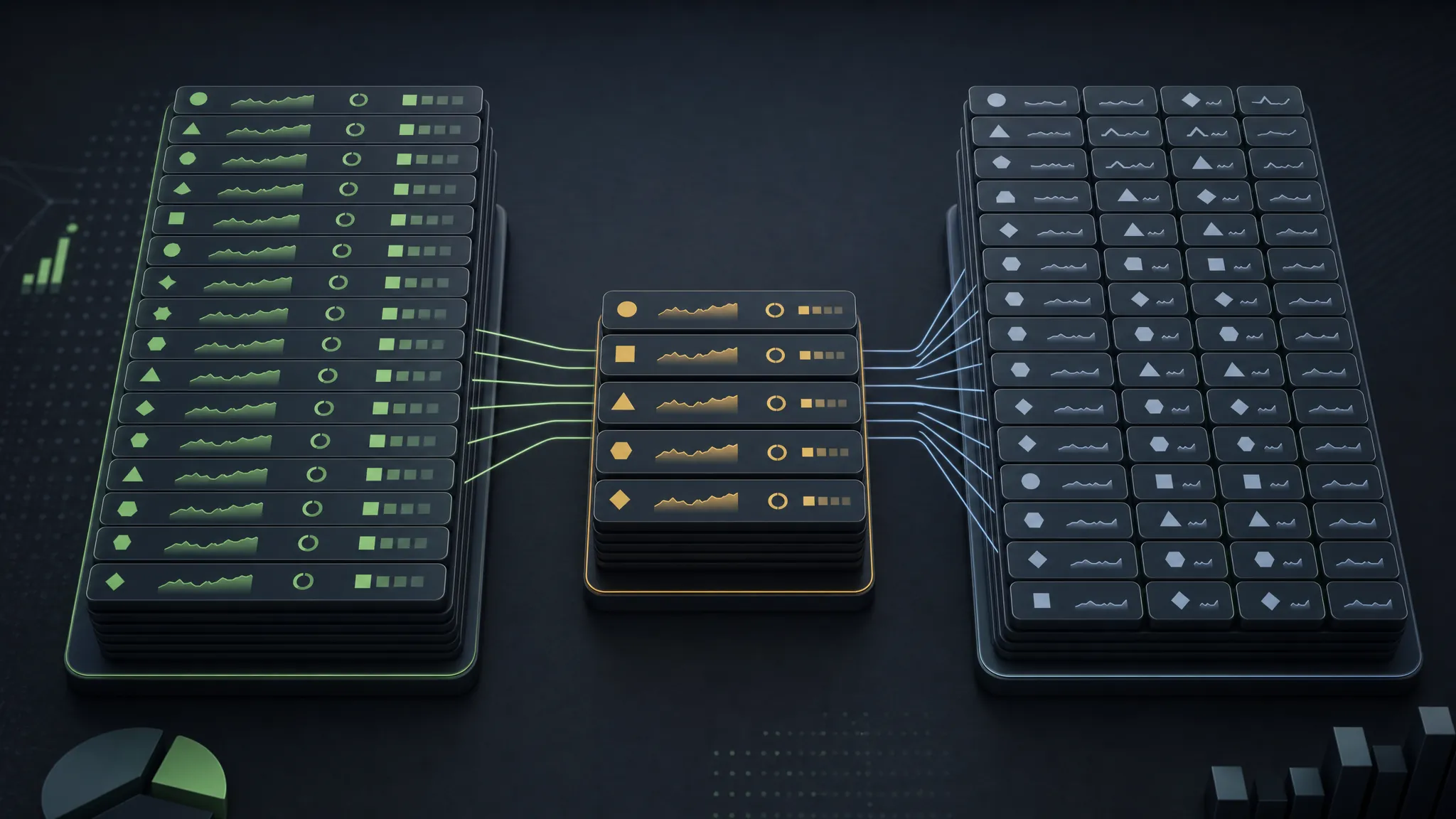
Full holdings describe what the ETF owns. A creation or redemption basket describes the securities, cash or other assets used by authorized participants to create or redeem ETF shares. Fidelity explains that a portfolio composition file is tied to the creation and redemption basket for the next trading day, and that it often represents a pro-rata slice or representative sample of the assets the ETF holds. Fidelity's explanation of ETF portfolio composition data is useful because it separates basket data from the broader holdings question.
Index constituents are different again. They describe the members of an index, not necessarily the ETF's actual portfolio. An index ETF may track an index closely, but the fund can still have cash, sampling choices, expenses, timing differences, securities lending effects, corporate actions or derivative exposure that make the holdings differ from the index list. If you need the ETF's real exposure, do not use the index as a shortcut unless your use case can tolerate that difference.
The fields that make holdings usable
A holdings row should do three jobs: identify the position, size the position and place it in context. Identification starts with ticker and name, but those are not enough on their own. Tickers can change, collide across exchanges or be missing for some instruments. Durable identifiers such as CUSIP, ISIN, FIGI or a vendor-specific key make matching safer. Exchange, country and currency fields help prevent false matches when global securities are involved.
Sizing fields tell you how much the fund owns. Quantity, market value, notional value, price and percentage weight help an analyst understand exposure. Weight is especially important because it shows the position's share of the portfolio. A tiny holding may be operationally present but analytically minor. A large holding can dominate performance, overlap and concentration checks.
Context fields make the file useful beyond a single lookup. Security type, sector, industry, rating, maturity, coupon, fund category, leverage, expense ratio and date all help turn a position list into a working data asset. AmericanETP's field definitions show the kind of column-level clarity a buyer should expect before wiring holdings data into a process.
Quick test for a holdings file
- Can each holding be matched without relying on ticker alone?
- Can weights, quantities and market values be reconciled?
- Does the file clearly identify cash, currencies, derivatives and fixed income positions?
- Does every row have a date that means the same thing across files?
- Can your team compare today's file with older files without manual cleanup?
How often ETF holdings are disclosed
In the U.S., Rule 6c-11 requires ETFs relying on the rule to disclose portfolio holdings each business day before regular trading opens on the primary listing exchange. The SEC's small entity compliance guide lists required holding-level details including ticker symbol, CUSIP or other identifier, description, quantity and percentage weight. The SEC's ETF compliance guide gives the regulatory baseline.
The practical question is timing. "Daily" does not tell you whether a file is available at 2:00 AM, before the market opens, after an issuer delay, or only after a third-party platform refreshes. If your workflow runs automatically, timing is part of the product. Unknown timing turns a clean-looking file into an operational risk.
The SEC staff has also emphasized why descriptions matter. In a 2024 staff statement about foreign currency holdings, the staff said identifying foreign currency simply as cash does not provide enough information for investors or market participants to understand the holding. The SEC staff statement is a reminder that holdings disclosure is about usable specificity, not just publishing a row.
How holdings change over time
ETF holdings change for several reasons. Index funds rebalance when the index changes. Active ETFs trade when the manager changes the portfolio. Bond ETFs replace matured bonds and manage duration, quality and cash flows. Leveraged and inverse ETFs may rebalance exposure frequently. Fund inflows and outflows can also affect cash and basket activity.
Market movement changes weights even when the share count does not change. If one stock rallies sharply while the rest of the portfolio is flat, its portfolio weight rises. That is why a file needs both position detail and dates. Without dated snapshots, it is difficult to separate trading activity from market movement or to explain when a position entered or left a fund.
Archives turn holdings into history. They let teams test exposure at a past date, rebuild a report, investigate a model result or review how a fund changed around an index rebalance. AmericanETP's data coverage and historical constituent archives are built for that kind of dated review rather than a one-day glance.
Where to find ETF holdings
The ETF issuer's website is usually the first place to check. Many issuers publish holdings pages or downloadable files. Brokerage and research platforms may also provide holdings, but the depth and timing can vary. For casual investing research, a public top-holdings table may be enough. For repeatable data work, you need to know whether the source provides complete files, consistent schemas, historical access and clear usage rights.
Specialist data sources can be more practical when the task involves many funds. DTCC says its ETF portfolio data covers thousands of U.S.-listed ETFs and includes daily consolidated portfolio composition files, pricing baskets when provided and historical data back to November 2007. DTCC's ETF Portfolio Data Service is one example of how holdings data becomes an operational feed rather than a single-fund lookup.
If you are comparing sources, ask for sample files, field definitions, update timing, archive depth and delivery options before you compare price. A cheaper feed that requires manual cleanup can become expensive quickly. A clean file that fits your workflow can save time every business day.
How AmericanETP helps teams work with ETF holdings
AmericanETP focuses on daily ETF and index constituent files for teams that want data they can inspect, import and archive. Current files include ETF constituent data, fund-level fundamentals, identifiers, sponsor sectors, prices, weights, shares, market values and related fields. The reports page shows the file and report paths available for evaluation.
The fit is strongest when a team needs repeatable CSV-based workflows rather than a one-off holdings lookup. Analysts can review fields before subscribing, developers can test import assumptions, and data teams can use dated files and archives to support reconciliation and history. The trial access path exists so a serious evaluator can look at the files directly.
Frequently asked questions
What are ETF holdings?
ETF holdings are the securities, cash positions and other assets held inside an exchange-traded fund. They are the fund's underlying portfolio, usually shown with identifying information, quantities and portfolio weights so investors and data teams can understand what the ETF owns.
Do ETF holdings change?
Yes. ETF holdings can change when the fund rebalances, when the underlying index changes, when the manager trades, when cash flows move in or out, or when portfolio values shift. Some ETFs change little from day to day, while active, leveraged, fixed income or thematic funds may require closer monitoring.
Do ETFs actually hold the underlying stocks?
Many equity ETFs hold the underlying stocks directly, but not every ETF is that simple. Bond, commodity, currency, leveraged, inverse and derivative-based products may include cash, futures, swaps, Treasury bills or other positions. The holdings file is where you confirm what the fund actually reports.
Are ETF holdings the same as top holdings?
No. Top holdings are only the largest positions, usually shown as a short list. Full ETF holdings should describe the complete portfolio or a much more complete data set, depending on the source and fund type.
Where can I find ETF holdings?
You can often find holdings on the ETF issuer's website, brokerage research pages, market-data platforms and specialist data feeds. For repeatable analysis, the important question is whether the data is downloadable, dated, complete, consistently formatted and available historically.
See the fields behind the fund.
Review AmericanETP's ETF constituent files, field definitions and sample reports before you build holdings data into your workflow.